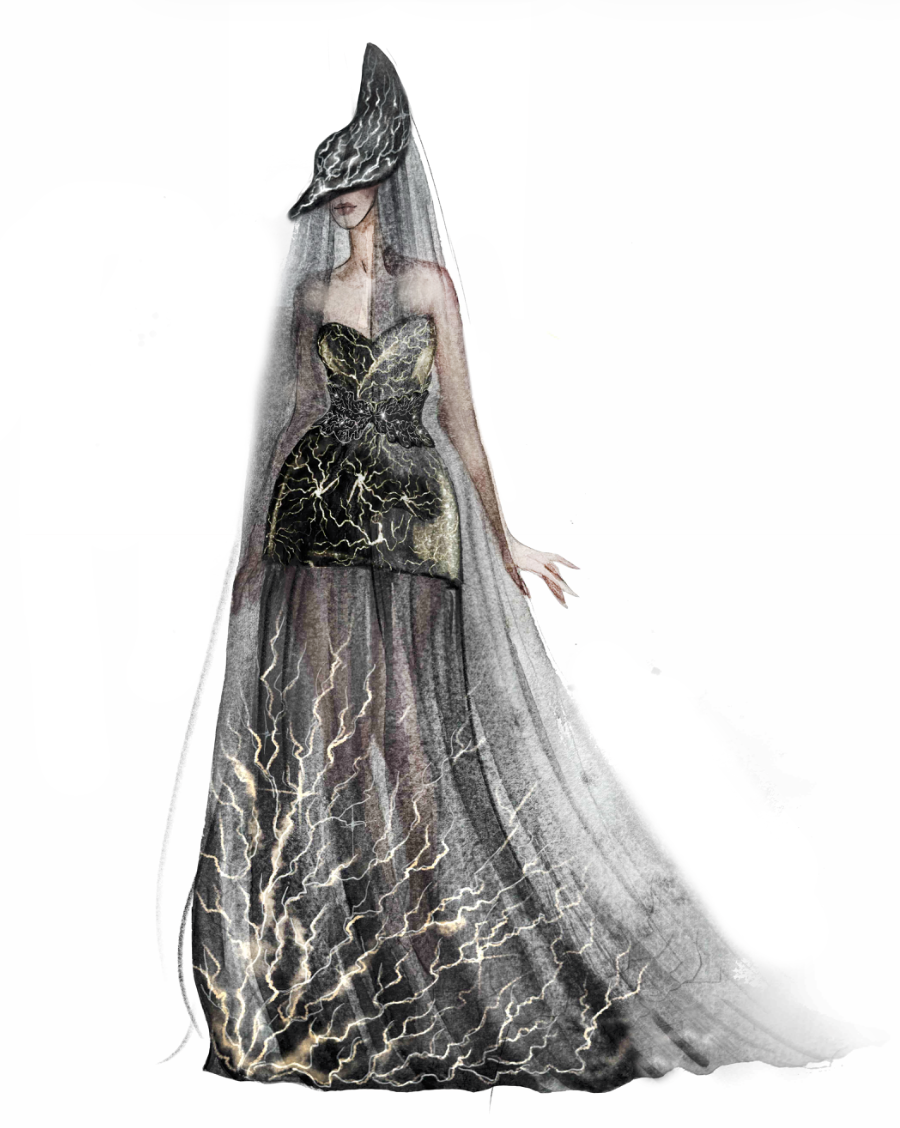
Your work blends fashion, art, and science. What was the starting point for this collection?
The title of the collection is ‘Sonic Starquakes,’ and it's quite a cosmic theme. I have not worked with such a grand subject in my shows before. I had it in my mind a few times, but it always felt too big. I like to zoom in, so some of my collections are very much about the microscopic. We tend to think from our own human scale of reality, so the microscopic world obviously is a very different reality, and then the macroscopic world is a very different reality.
I’ve had this idea in my mind to create a look that is immaterial or is like an atmosphere or an energy alone, and I think [a dress in the collection] is the closest that I've come because it's made with plasma and it responds to the movement of the body. It’s the combination of the glass holding it to or grounding it to earth, but then the plasma having its own life inside, and that is one of the centerpieces of the collections. It has been a big challenge to get there, but I think it's one step closer to that very immaterial and pure vision that I've had in my mind for quite a while.
In a world defined by speed and algorithms, what place does haute couture have today?
Couture is the opposite of the speed of the world that we're living in today, because it slows you down, it gives you the appreciation of human creativity, but also the human hand. I only show an annual show, so we've been working on this collection for 12 months, and there is such an incredible layering of craftsmanship inside that it takes three to four months to make one look. It’s almost like a meditative state. Often people think of fashion as people running around and craziness, but couture is really a space of peace and meditation. If you are able to achieve that amount of hand work in a look, you really need to be in the here and now. That’s the only way to do it, and I think that's what keeps me doing couture. It's a beautiful space to be in. It’s very similar to an artist, where a painting can take months and months to make, and there is no planning behind it. That's also impossible with the complexity that goes into the work.
It’s an intuition. The majority [of people in the atelier] come from a fashion background, but then there's also some people with engineering and architecture. If we go highly-specialised, like this show with the plasma and Lichtenberg technique, then we usually collaborate with scientists and or artists. We bring in different expertise. It requires multiple people, so they are like mentors. I would call them collaborators, but they're much like mentors, guiding us through the process. It’s bringing science into a very intimate setting of couture. I remember visiting CERN, the Large Hadron Collider, and I was so moved. To me, it's one of the most beautiful spaces or places on earth, where scientists are able to communicate with the tiniest atoms that we’re made of, and I think not so many people see it also in the perspective of art. When I'm at a science research centre like that, I see the art of it as well, and also the way it expands our reality.
How do you define craftsmanship?
It’s to me always a combination between something more spiritual and untouchable and something very physical. It’s in that dialogue when the two come together, and that’s when it gets interesting. There’s no such a thing as the hand creating magic if the mind is not linked to, or tapped into the right mindset. Couture and craftsmanship has always been about innovation. If you look at the history of craftsmanship, everything that we look at now as sort of historic was pure innovation at the time it was invented, right? It goes back to inventing the needle, which was highly innovative, or even lace-making, or the plissé techniques. A lot of the techniques that we use in the atelier now were important steps of innovation in the past. I don’t see what I’m doing now as anything different than continuing that evolution of craftsmanship with the contemporary tools that are available today. When we work with a particle accelerator, it's a tool of innovation that we have available today, and it's almost like a time travel of all these different techniques.
Have you witnessed a change in how audiences respond to haute couture over time?
More and more people are embracing couture as a pure form of art. It’s the right mindset where the work or the craftsmanship that goes into couture is really appreciated, and the creative process behind it is also evaluated as being art. For the past 20 or 30 years, museums have started to collect more and more fashion and couture which is a beautiful movement. They have always collected fashion but I would say there's much higher focus on the contemporary. Exhibitions are playing a big role in that as well, where you have much more fashion exhibitions going on into the museums, or even permanent sections in the museums, where people can explore art. Andrew Bolton expressed it really beautifully, when the [Metropolitan Museum of Art in New York] opened the new permanent space in the museum, and he said that he realised that all the different departments in the museum are all tied together by this one medium, which is fashion.
This interview has been lightly edited.