In your view, how important are tradition and identity in contributing to the coherence of today’s Maisons?
Tradition, in my view, is not the preservation of relics from the past, but rather a ‘Standard’ that relentlessly updates the definition of supreme quality. My identity is rooted in Kiryu, a city of textiles with 1,300 years of history; yet, the techniques we employ there are by no means fossilised. For instance, the Rayon thread I favour is dyed using Kiryu’s unique ‘Vat Dyeing’ technique. This possesses extreme lightfastness and durability, retaining its vivid colours even after decades in a museum. Furthermore, we are likely the only ones in the world capable of manipulating traditional Japanese ‘Gold and Silver threads’ and ‘Urushi (lacquer) thread’—with its unique lustre and hardness—using the Yokoburi (horizontal) sewing machine, a mechanism born in Kiryu. The ‘coherence’ required by today’s Maisons lies not in brand logos, but in the ‘material strength’ that does not fade even when archived one hundred years hence. My embroidery guarantees precisely that strength.
Haute Couture has become widely popular due to hyper-communication. Is this an advantage or a disadvantage?
I consider it an advantage. The advancement of information technology has increased transparency, shedding light on places that were previously in shadow, and extending the hand of interpretation to the magic of creation. My archaic techniques are now being explored for collaboration by young AI engineers from MIT. Moreover, precisely because we are in an age of screens, there is a rising craving for ‘texture’ and ‘tactility’ that cannot be conveyed digitally. The profound lustre of Urushi thread or the grave weight of gold thread cannot be understood without physical touch. In a sea of excessive information, I am convinced that the ‘silent eloquence’ possessed only by genuine matter will become the true luxury of the future.
How can the slow process of creating Haute Couture coexist with today’s fast-paced society?
It is a coexistence achieved through ‘Hybrid Thinking’, which harmonises elements that appear contradictory. While the warmth of blood circulation and the depth of expression inherent in analogue handwork require exceptional skill and time, we do not reject technology. By having skilled artisans intervene from the initial planning stages, utilising AI and digital analysis to construct the base, and entrusting the final ‘soul’ to the craftsman’s technique, we can implement the ‘beauty of transience’ crystallised in couture creation, even within a fast-paced society.
How do you see the future of Haute Couture?
I see it as the liberation from material constraints. It will be free formation, unbound by gravity or existing concepts of cloth. I expect it to continue functioning as an apparatus that embodies humanity’s ‘dreams’ and ‘hopes', a raison d’être that cannot be reached by rationality or efficiency alone.
What is the most significant change currently seen in the fashion world?
The ‘Visualisation of the Invisible’. Material production regions and artisans, who were once kurogo (stagehands dressed in black), have begun to step onto the main stage as partners in creation. The public acknowledgement of the fact that the technology of a regional city like Kiryu (a production centre unique to Japan) supports the runways of Paris is a great hope for the next generation of artisans.
What is your view on the role of new technology in Haute Couture?
Technology is my ‘extended fingertips’. I am by no means a nostalgic. In my collaboration with Yuima Nakazato, we sewed Spiber’s Brewed Protein, a cutting-edge fibre, using my old horizontal sewing machine. It was the moment when biotechnology conversed with a machine that has been operating with me for over half a century. We also borrow the power of chemistry. When Water-soluble Vinylon was first developed, we refined it with our techniques upon the manufacturer’s request. By using it as a base or a composite material for alignment, and dissolving it after the embroidery is complete, we succeeded in creating ‘thread sculptures floating in mid-air’ where no fabric exists. This is an architectural approach that designs the very structure of the crossing threads and the embroidery itself. Taming new technologies (Spiber), chemistry (Vinylon), and traditional Japanese threads with skilled somatic knowledge, and that is my role.”
What excites you most in fashion right now?
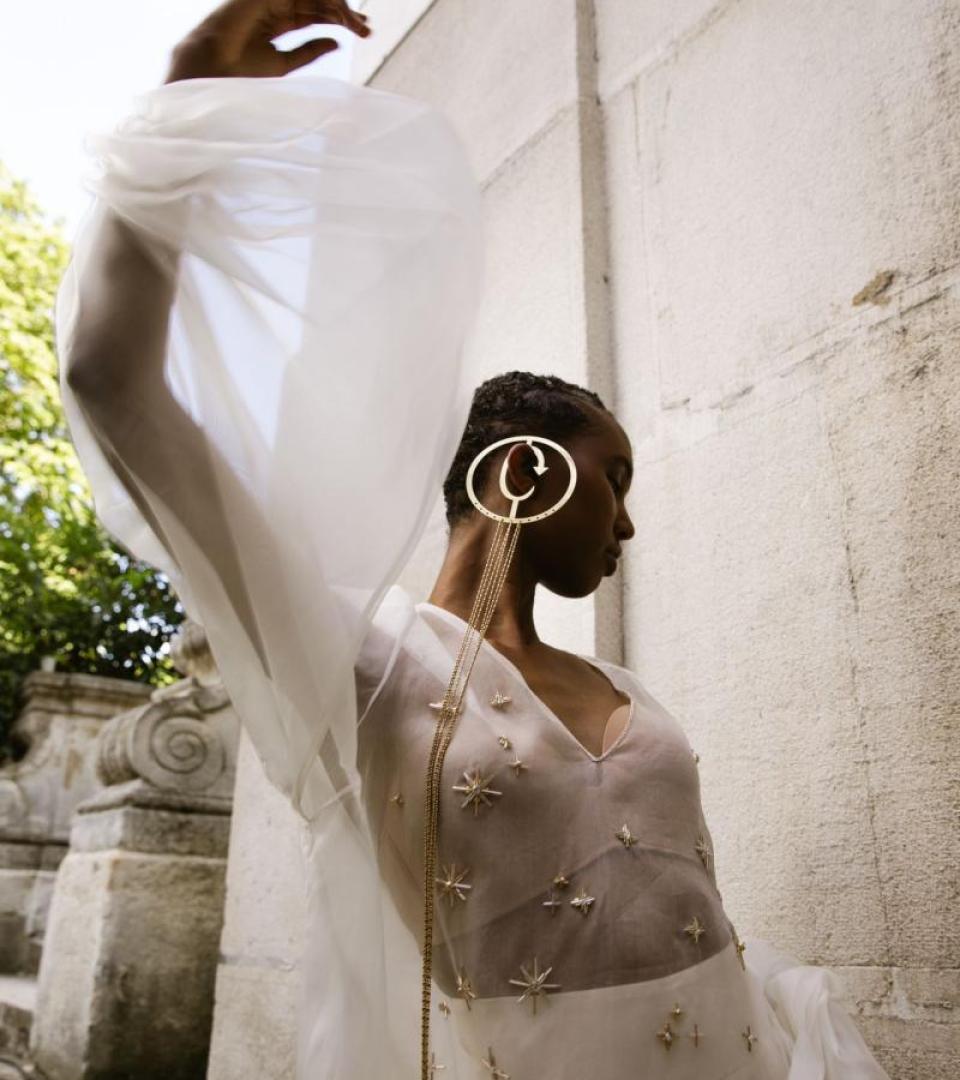
The possibility of clothing as ‘Healing Armour’. By applying the technique of water-soluble Vinylon, we can create garments like the ‘Tennyo no Hagoromo’ (Celestial Maiden’s Raiment), light as air, yet enveloping the body. Regardless of physical handicaps, a second skin composed solely of thread heals the wearer’s mind and body. Not heavy metal armour, but armour of thread that harbours the wind. Since ancient times, plant-dyed threads have served as medicine, and silk is the material closest to human skin, wrapping people with prayer. I am most excited by the creation of such clothing where medical care and beauty merge, arising from recent technological innovations.
When was the last time you marvelled at something in fashion?
Always present in my heart is the work of the late Junichi Arai, a textile planner from my hometown of Kiryu. From the era when we co-created developments as comrades, just as he revolutionised the concept of ‘cloth’ with chemistry and passion, I wish to astonish the creators of Paris with ‘thread’ and a sewing machine.