Actualités

Fidan Novruzova’s Vanity Project

Interviews

By Paul McLauchlan

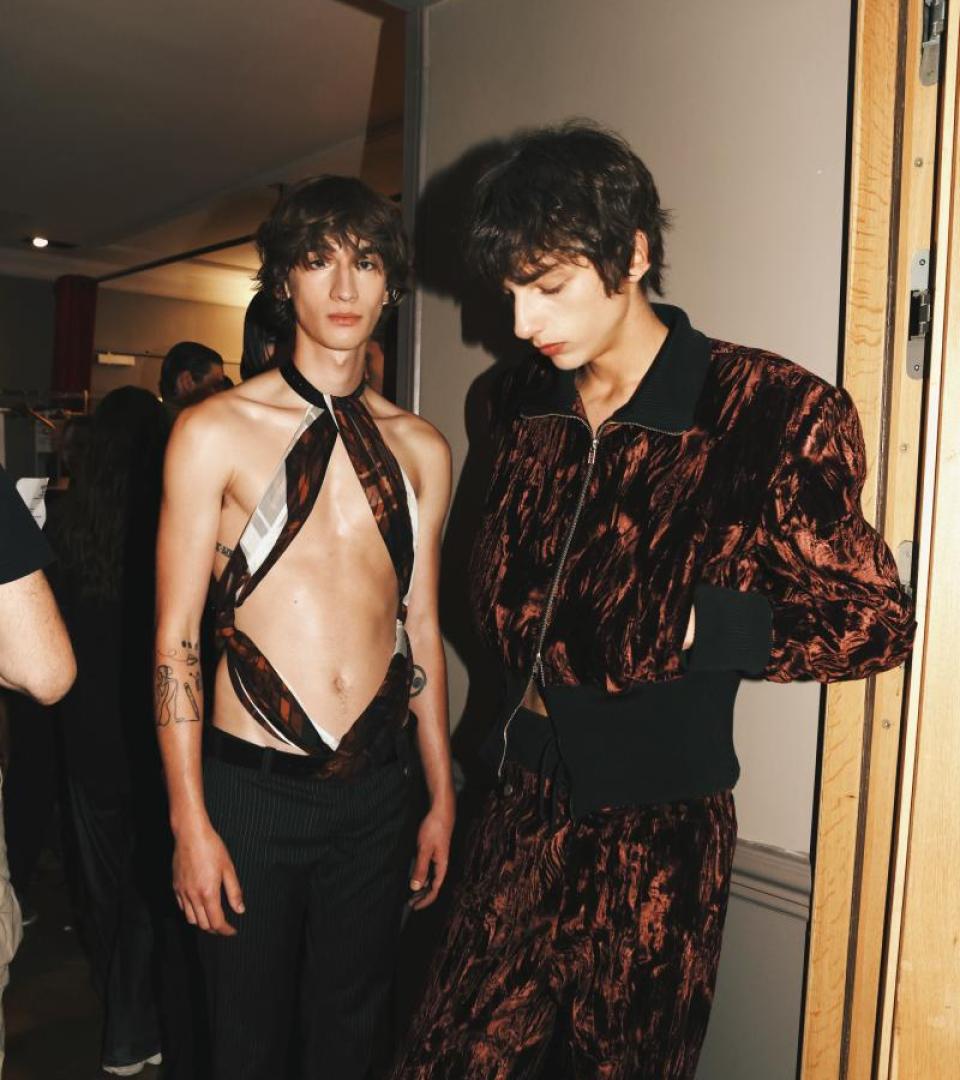
Fidan Novruzova drew comparisons between the inherent contradictions of Instagram-age narcissism and the work of artist Mara Goldberg, but there is nothing conceited about her Spring-Summer 2027 collection, entitled La Vanité. Suitably staged in an art gallery in Saint-Germain-des-Près featuring large windows, mirrored walls, and lacquered surfaces designed by set designer Polly Philp, the Moldovan designer presented an unexpected mix of colour, texture, and silhouette, embodied by the archetype of a nonchalant chalant woman.

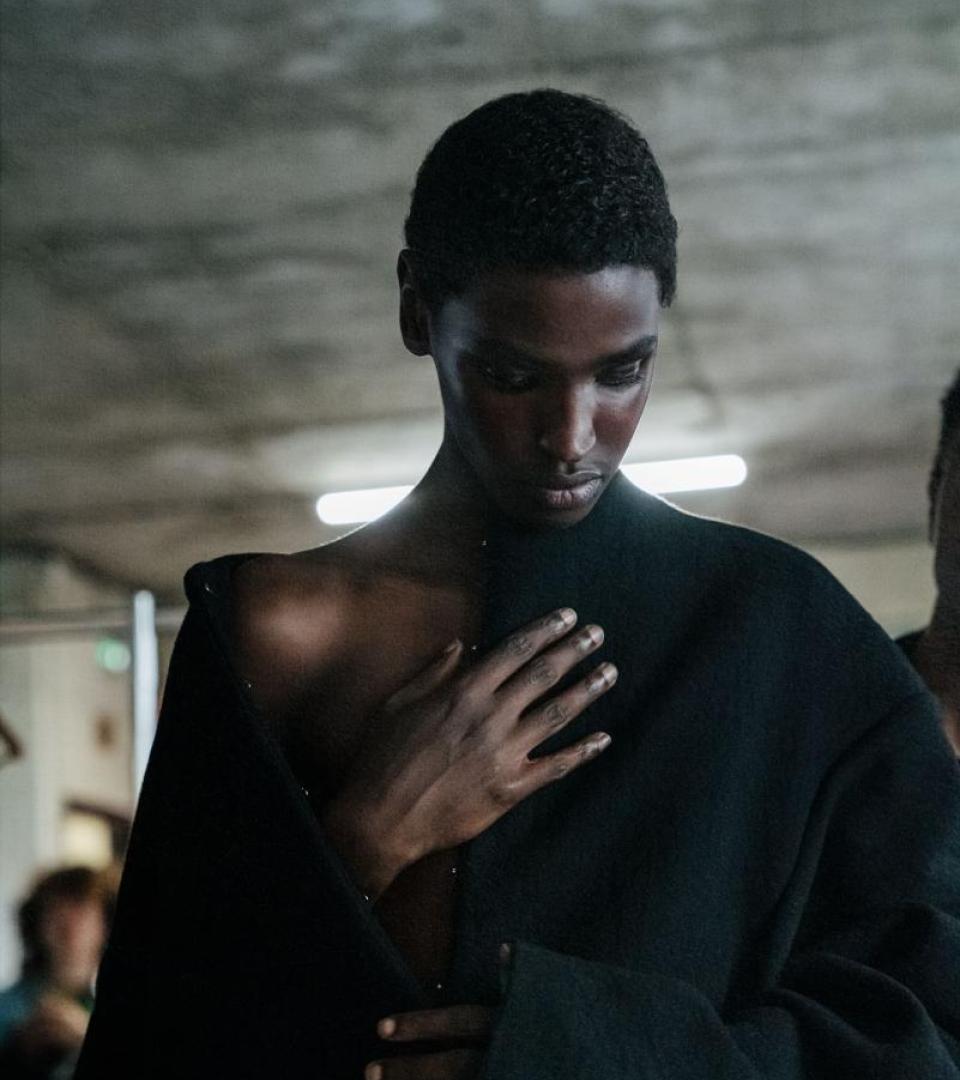
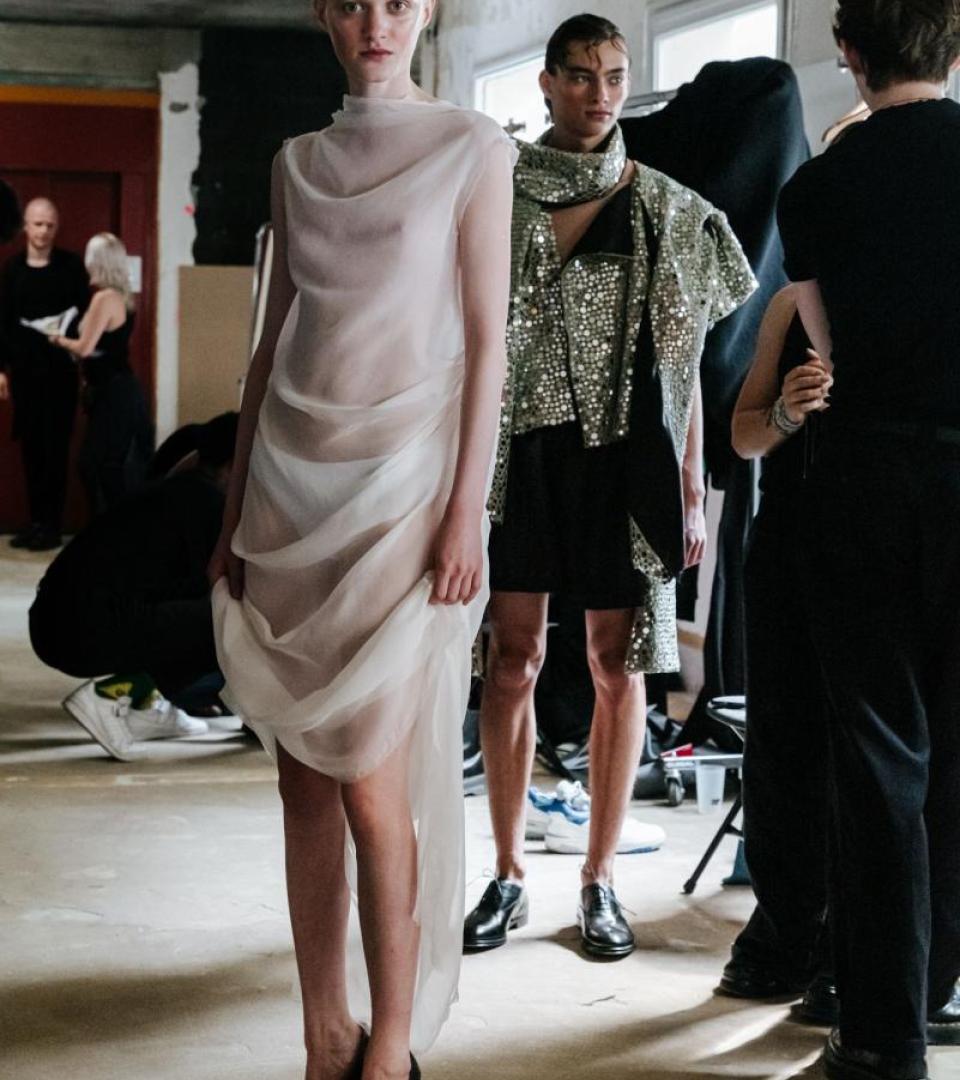
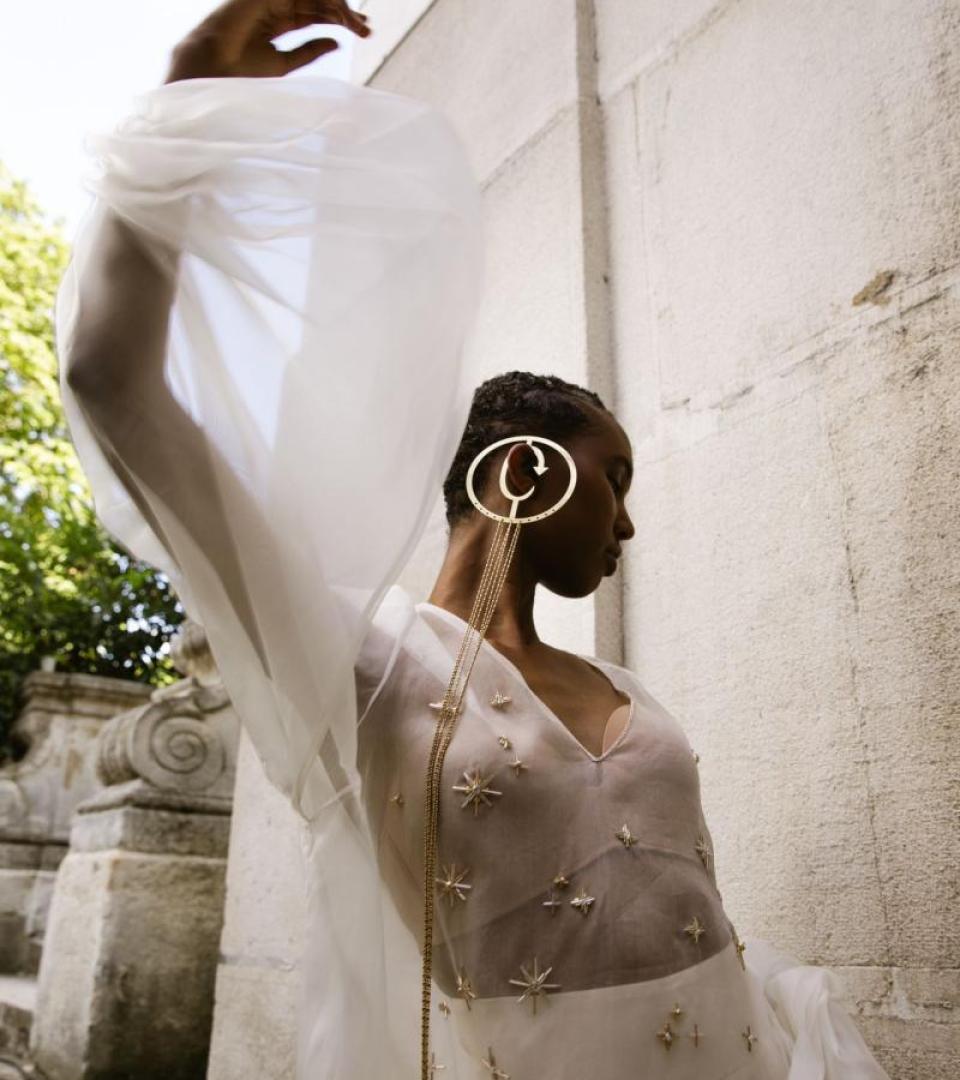
Her most feminine outing yet, Novruzova dissected the duality by dispensing some everyday occasionwear, as she calls it, with her usual 1920s-meets-1980s flair. She enlisted print designer Fiona Blakeman for some lettering, riffing on her name emblazoned on skirts and kitschy leopard print. Though Novruzova is intent on keeping things playful, she elevated her fabrications by sourcing silk, chiffon, and viscose in Italy, alongside her introductory knitwear offering. Evoking Goldberg’s oeuvre, which explores the interplay of good and bad taste through uncanny material, textural, and chromatic permutations, she contrasts softer fabrications with synthetics like neoprene and coarser materials like cotton gabardine. The accessories are naturally covetable; the ‘Mira,’ a deep structured bag reminiscent of a vanity case, derives its name from both the phonetic play and Novruzova’s niece, while a compact coin purse resembles a makeup sponge, equipped with a mirror no less.

“Considering that I started [my brand] when I was fresh out of university, it’s important for me, and the brand, to respond to my needs as a woman,” said Novruzova from her Paris studio.

What was the first thing that set the SS27 collection in motion — a fabric, an image, a silhouette or something more instinctive?

The thing that started the process was artist, Mara Goldberg. I love the range of colours. It’s a very intuitive mix of colour and texture, organic and man-made. It’s sculptural but soft at the same time. Sculptural is something that’s more my comfort zone when it comes to clothing and accessories, but it pushed me into exploring another side of me, as a designer. I’ve travelled half of Italy this season to get more refined and traditional fabrics like silk, chiffon, and wool. We also have some neoprene and cotton gabardines. With her work being the starting point, I wanted to go beyond just the clothes and an exploration of novelty. It’s definitely more feminine and soft compared to what I’ve done in the past. Those urges come from a place of myself growing and evolving with my brand. 


You often begin with materials before you begin sketching. Was there a particular fabric or construction this season that changed the direction of the collection? 

I wanted to explore more variations of the Fidan girl silhouette. The lengths are a bit longer in some places, longer than we’ve ever done before, and shorter in others. It was a great challenge for us to work with softer fabrics. We’ve also introduced knitwear this season, with elongated collars, like we’ve done in the past with outerwear; but it was interesting to see in knitwear format. I’ve been very experimental with some deconstructed forms, but I’m always careful around deconstruction because it needs to have meaning and purpose to make sense. When you’re making a garment from scratch, you need to understand why you’re going to displace it from its traditional outline. I call it constructive deconstruction.


With the idea of vanity playing a central role in the collection’s inspiration, how do you think building a business in the social media age has influenced your role as a designer?

The era of the introverted designer is, unfortunately, over. People go into this world because it's such an intimate process where you share your thoughts in the world but it’s quite an illusion to believe that you do this in solitude. In reality, you have to communicate and collaborate with so many people to make a collection happen. 


You’ve described the brand as moving from something very editorial towards building a wardrobe. How far can you push that idea of wearability without losing the eccentricity that makes the clothes recognisably yours?

The questions that I ask myself throughout the process are whether it’s something that I truly want to wear, or if it’s something that I would feel good in. I feel like if all these eccentricities correspond, especially to the second part, it can exist within the collection. The desirability has to be there. It all starts with the crazier pieces and then the simpler things come along the way. You build it as you go. I admire those designers who have a whole collection sketched and they just make it. Unfortunately, I’m not that designer. I build collections based on fabrication – and in the last few seasons, colour, which is not something I used to do. That’s the beauty of having your own brand: the amount of learning that takes place. I feel like I did a master’s program in the studio. 


This interview has been lightly edited.