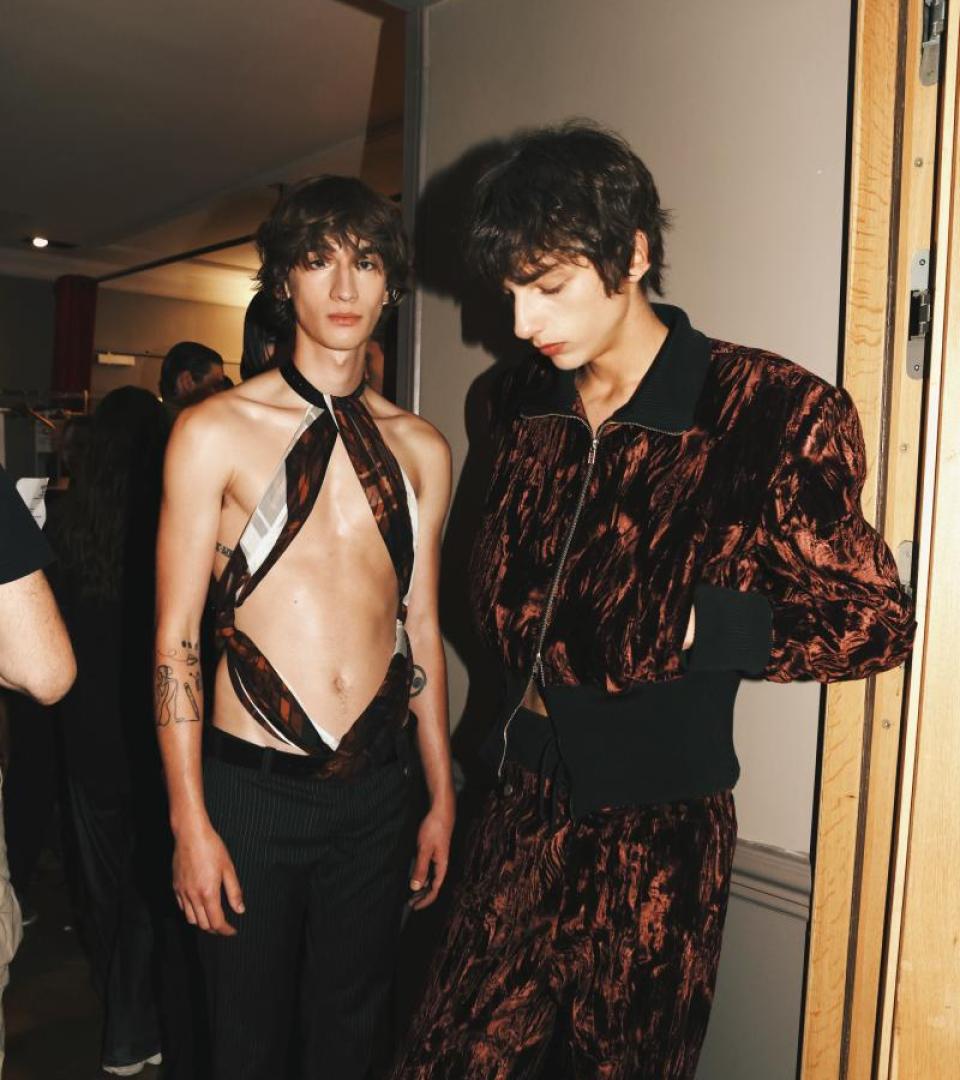
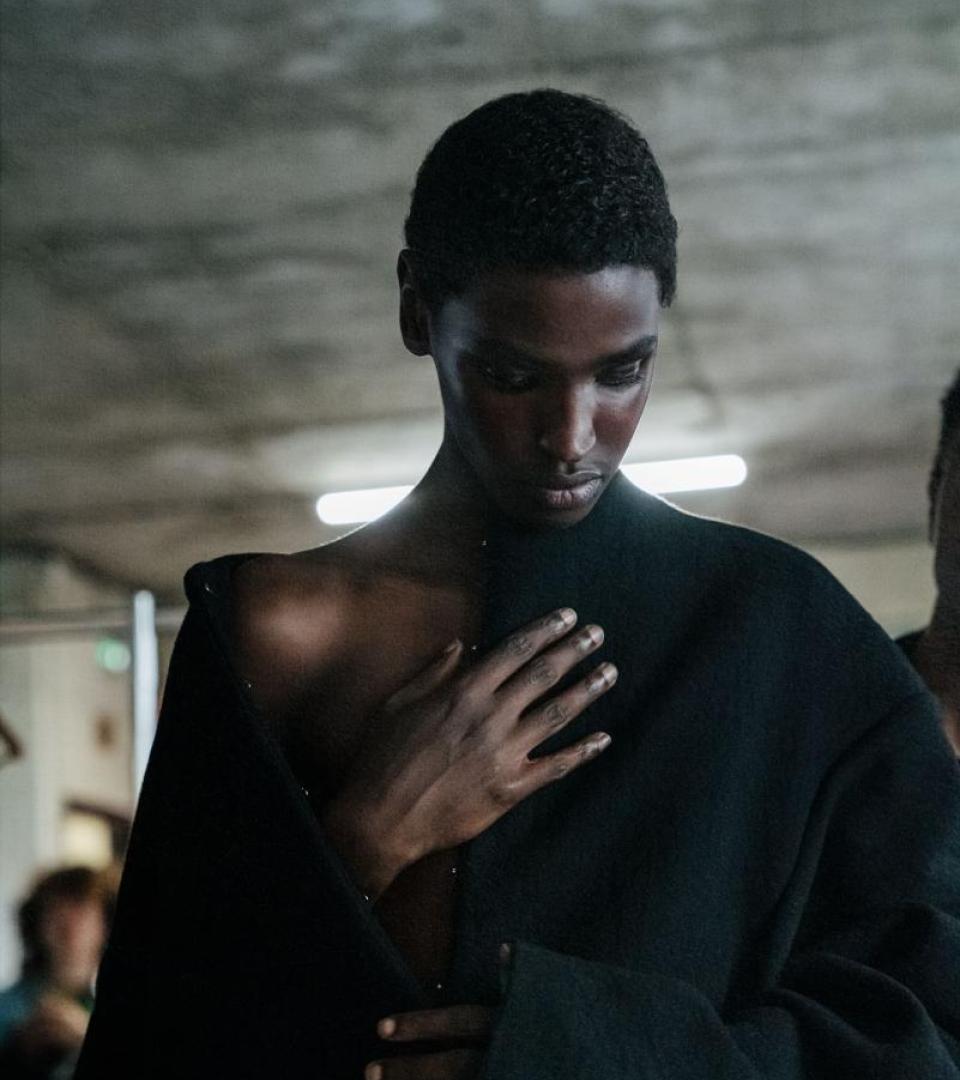
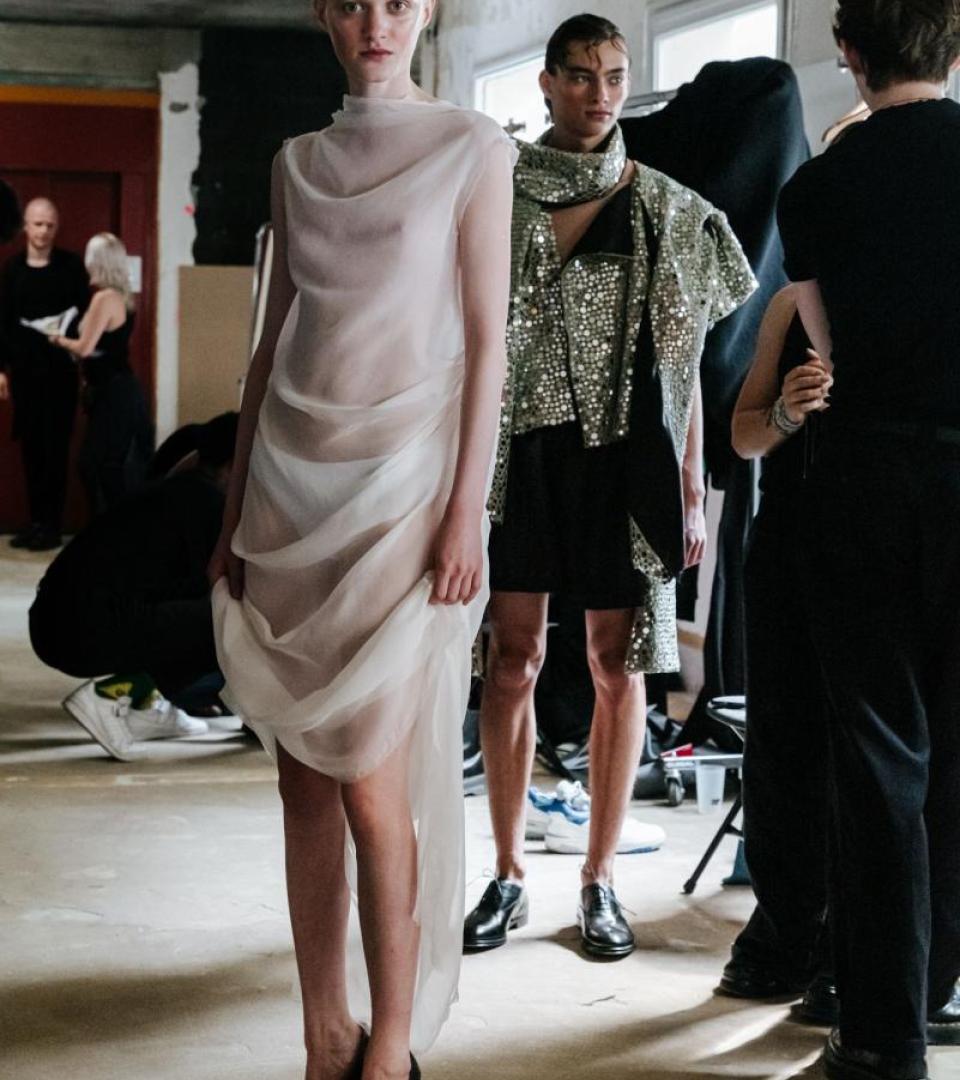
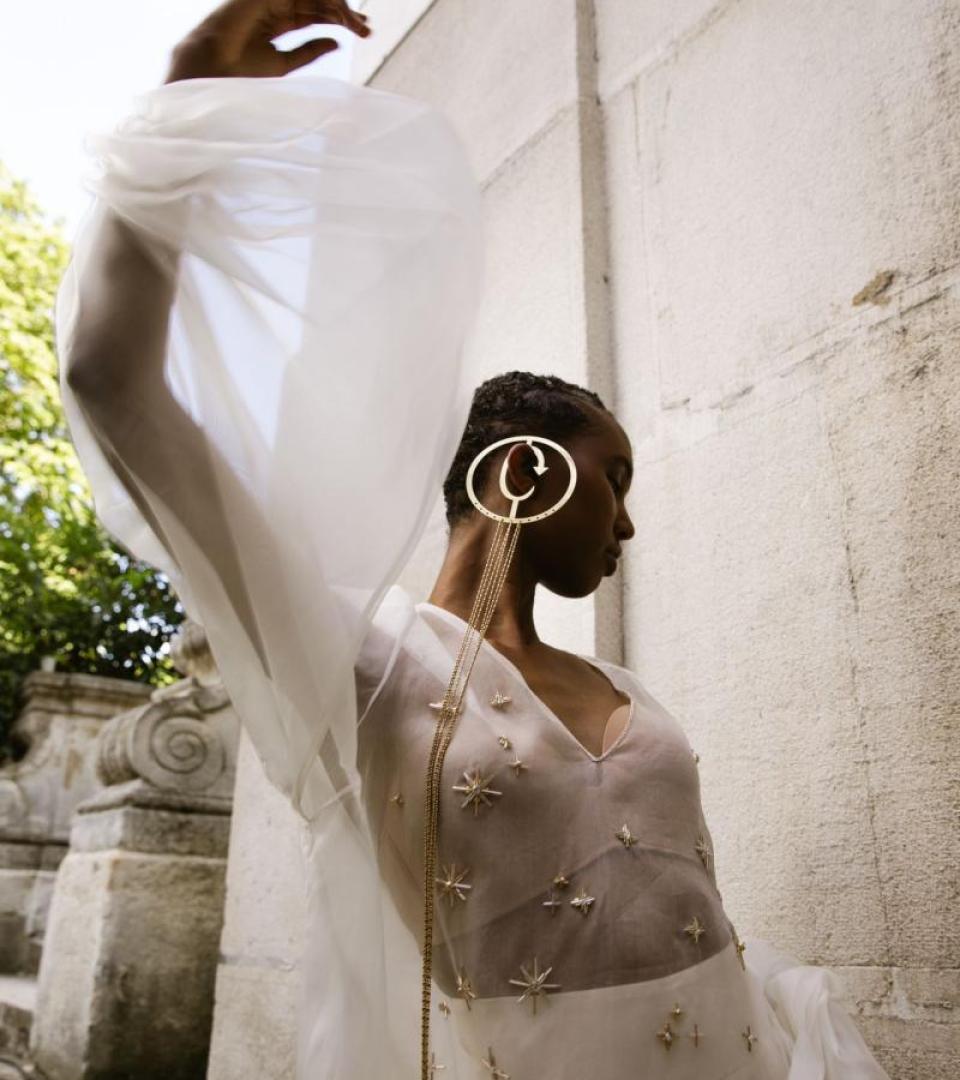
EENK
Print, language and structure are not references in Hyemee Lee’s work; they are its grammar. Founder and creative director of Eenk, she conceived the brand in 2013 as an evolving “Letter Project,” each collection unfolding like a chapter in an alphabet of silhouettes, fabrics and ideas. The name Eenk itself is a playful shift from the word “ink,” the doubled E echoing the repeated letter in her own name, Hyemee Lee. Trained across womenswear and menswear, with early roles spanning Time Homme, System Homme and Monday Edition, she brings both rigour and breadth to her practice. Under her direction, Eenk has moved steadily from Seoul to Paris, presenting on the official calendar while retaining a distinct editorial clarity. Lee designs as one writes: assembling fragments, refining tone, and allowing garments to form sentences that are modern yet quietly idiosyncratic.
Where do you look for new ideas or voices in fashion?
I draw inspiration from the ordinary rather than the monumental. A scene from a film, an old vintage magazine, an archival garment photograph, or a quiet conversation can become a starting point. When such moments intersect with a particular emotion or a contemporary issue, a new question begins to form. I often return to the archive. I revisit past structures and consider how they might connect to the present. I am less interested in inventing something entirely new than in reinterpreting what is already familiar. A collection evolves more in the process than at its beginning. Through revision, dialogue, and experimentation, perspective emerges. Ultimately, every decision is a result of accumulated experience.
What excites you in fashion right now?
What I find most compelling today is the relationship between a house and its creative director. Fashion is no longer solely about design; it is also about structure and leadership. The legacy of a house and the director’s personal vision intersect, creating tension and negotiation. This dynamic goes beyond personnel changes. It raises fundamental questions about identity, direction, and long-term continuity. At times, a new interpretation revitalizes a house. In others, the search for balance itself signals evolution. Fashion today moves quickly, yet it is asking deeper questions than ever.
What surprises you the most?
What surprises me most is the rapid dissolution of geographic boundaries. The distinction between centre and periphery has become increasingly irrelevant. Brands from diverse cultural backgrounds are now recognised within a shared contemporary framework. Digital platforms have accelerated the circulation of ideas, allowing multiple cities and cultures to engage in real-time dialogue. This is not simply market expansion; it is the evolution of fashion into a truly global conversation. Fashion is one of the few languages capable of crossing borders while retaining local nuance. The industry has never been more open.
What is one reason to be optimistic about the state of fashion going forward?
I remain optimistic about fashion because it continues to carry emotion. As technology advances, human taste and attitude become even more significant. People still use clothing to express themselves. In an era driven by efficiency, anything capable of conveying emotion becomes more valuable. Ultimately, fashion is about people.
In which ways might fashion creativity effectively drive growth?
Creativity shapes a brand’s emotional identity and differentiation. However, it contributes to growth only when it operates within a clear direction. I constantly navigate the tension between commercial reality and experimentation. Excessive commercialism flattens a brand; excessive experimentation undermines sustainability. Creativity initiates a brand. Consistency sustains it. When creativity functions within a structured system, growth becomes possible.
How essential is heritage and/or a distinctive identity in contributing to a brand’s success?
In today’s environment, heritage and distinct identity are more critical than ever. In a saturated digital landscape, even gaining attention is difficult. Heritage is not merely age; it is the record of consistent standards upheld over time. Anyone can generate ideas. Few can sustain identity through time. Longevity has become one of the strongest competitive advantages.
Who or what is generating the greatest influence in fashion today?
The most powerful force in fashion today is the ability to move emotion. Audiences are no longer persuaded by insistence or noise. They respond to coherence, authenticity, and emotional resonance. Fashion still creates anticipation, confidence, and connection. In an AI-driven era, human emotion will only grow more central.
How do you think your brand can spark and sustain desire with so much else going on in the world?
I believe interest should be built structurally rather than generated through short-term provocation. Eenk connects seasons through an alphabetical framework, allowing each collection to function as a chapter in a larger narrative. We continually reinterpret classic garments and design open structures that invite personal styling. The wearer becomes an active participant. Interest endures through trust, not spectacle. Quiet consistency is our most realistic strategy.
Do trends still matter?
Trends are a language for understanding the present. As a designer, I observe them. As an operator, I analyse them. But I aspire not to follow trends, rather, to interpret and propose. Remaining connected to the moment while maintaining a clear center is essential. That balance is what allows a brand to endure.
There seems to be more overlap between fashion/entertainment and fashion/sports than ever. Thoughts?
I see the overlap between fashion, entertainment, and sports not as dilution, but as expansion. Fashion has always been present in these fields. What has changed is its visibility and influence. It has become a primary vehicle for expressing identity. Clothing remains one of humanity’s most instinctive forms of expression. In that sense, fashion is not merging into other industries — it is moving toward the centre.
In what ways is AI helping you develop and realise ideas that might not have been previously possible?
I use AI less as a production tool and more as a thinking partner. It does not replace ideas, but it helps refine questions. It challenges assumptions and sharpens perspective. Final decisions, however, remain human. Fashion ultimately belongs to the realm of emotion.
Your brand is relatively young. How do you think you can develop it in the current fashion scenario?
Although Eenk is a relatively young brand, it has experienced multiple phases within a short time. Rather than prioritizing speed, we have focused on building structure. The alphabetical framework allowed experimentation while maintaining continuity. We are now in a phase of refinement, clarifying our aesthetic rather than expanding outward. Growth, to me, is not scale but clarity of standards.
Can you share a mantra that speaks to this moment in time?
I often think of the phrase “La vie en rose.” Not as romantic nostalgia, but as a deliberate perspective. It represents the choice of how one sees the world. Rather than following trends, I believe in interpreting the world through the lens we consciously choose. Standing firmly within that chosen perspective defines this moment for me.
What do you enjoy most about Paris Fashion Week?
What I value most about Paris Fashion Week is collaboration. Artists from different disciplines come together and exchange sensibilities within a compressed timeframe. Despite distinct languages, a shared resonance emerges. The energy generated through this exchange is transformative. For my team and I, those moments of collective creation are profoundly meaningful.
This interview has been lightly edited.